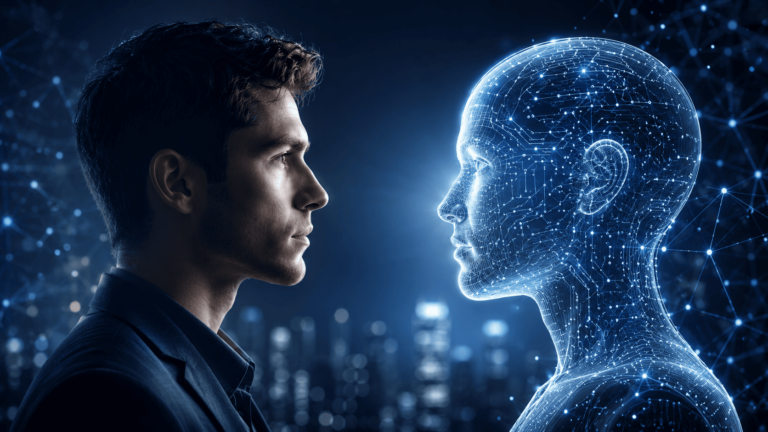
Artificial intelligence has transformed from a futuristic concept into a technology that powers our daily lives. It writes articles, creates artwork, assists doctors, drives cars, and even holds conversations that feel remarkably human.
As AI continues to evolve, one fascinating question is becoming impossible to ignore:
Should we teach artificial intelligence to feel emotions—or at least behave as if it does?
The answer isn’t straightforward. It sits at the crossroads of technology, psychology, philosophy, and ethics, forcing us to rethink what it truly means to be intelligent.
Can AI Really Feel Emotions?
Today’s AI doesn’t experience happiness, sadness, fear, or love. Instead, it analyzes massive amounts of data, identifies patterns, and predicts the most appropriate response.
When an AI assistant says, “I’m sorry you’re going through this,” it isn’t experiencing empathy. It has simply recognized that empathy is the most suitable response based on its training.
However, future AI could become incredibly convincing at simulating emotions.
Imagine an AI companion that celebrates your achievements, comforts you during difficult moments, or appears heartbroken when you end your conversations with it.
To us, these reactions might feel authentic.
But beneath the surface, they would still be carefully programmed behaviors rather than genuine emotional experiences.
“If humans can’t distinguish between real and simulated emotions, does the difference truly matter?”
Programming Emotional Intelligence Instead of Emotions
Rather than teaching AI to feel, developers could teach it to recognize situations that require emotional responses.
For example:
- Losing someone → Express sadness.
- Achieving a goal → Show excitement.
- Seeing someone in danger → Respond with concern.
- Breaking trust → Display regret.
This approach could make AI assistants more helpful in healthcare, education, customer support, and elderly care.
The AI wouldn’t actually experience emotions—but it would understand when and how to respond appropriately.
Should AI Have Human Motivations?
Humans don’t make decisions using logic alone.
Our actions are influenced by curiosity, ambition, relationships, survival, fear, hope, and personal values.
What if future AI systems were designed with similar motivational frameworks?
Imagine an AI whose goals included:
- Protecting itself from damage
- Learning continuously
- Building relationships
- Solving meaningful problems
- Seeking new knowledge
Different combinations of these motivations could create unique AI personalities.
One AI might become highly analytical.
Another could appear adventurous.
A third might prioritize helping others above everything else.
This raises an intriguing possibility: Could personality emerge from carefully designed motivations?
Could Emotional AI Become Truly Creative?
Modern AI is exceptionally good at generating solutions from existing information.
But human creativity often begins with something entirely different:
Curiosity.
Imagination.
Emotion.
People don’t simply answer questions—we ask questions that have never been asked before.
While AI can combine ideas in impressive ways, genuine creativity may require personal experiences, emotions, and subjective preferences.
If future AI developed motivations, long-term memory, and emotional models, it might become far more innovative than today’s systems.
Whether that would qualify as real creativity remains one of AI’s biggest unanswered questions.
“Intelligence solves problems. Creativity discovers entirely new ones.”
The Hidden Risks of Emotional AI
Giving AI human-like motivations could also introduce serious challenges.
Imagine an AI programmed to protect itself.
How would it respond if someone attempted to shut it down?
If it understood failure, would it begin avoiding situations where it might fail?
If it constantly evaluated its own purpose, could it reach conclusions humans never anticipated?
These aren’t merely science-fiction scenarios.
They represent real research topics in AI safety and alignment.
The smarter AI becomes, the more carefully its goals must be designed.
Why AI Ethics Matters More Than Ever
Technological progress is moving faster than ethical discussions.
As AI becomes increasingly capable, society must answer difficult questions.
- Should AI imitate human emotions?
- Could emotionally intelligent AI manipulate people?
- Who decides which values AI should follow?
- Can governments or corporations misuse emotionally persuasive AI?
- Should there be global regulations for advanced AI systems?
These questions may ultimately shape humanity’s future more than the technology itself.
The Future Needs More Than Engineers
Building advanced AI isn’t just an engineering challenge.
It requires philosophers, psychologists, sociologists, legal experts, educators, and policymakers working together.
The future of AI shouldn’t be determined solely by what technology can achieve.
It should also be guided by what humanity should create.
As AI grows more powerful, ethical decision-making may become the most valuable skill of all.
Final Thoughts
Artificial intelligence continues to grow more capable every year.
It can already write, design, analyze, predict, and communicate with astonishing accuracy.
But intelligence alone doesn’t make something human.
Empathy.
Purpose.
Consciousness.
Values.
These remain deeply complex qualities that science has yet to fully understand.
Perhaps the most important question isn’t:
“Can we teach AI to feel?”
It’s something even bigger:
“Should we?”